Sefer Ha-Hayim Blog
Thursday, May 29, 2008
Rabbi Jacob Joseph in the News
The current issue of The Jewish Press quotes the book Rabbi Israel Salanter: Religious-Ethical Thinker (link):Rabbi Jacob Juspha, better known as Rabbi Jacob Joseph, was born into a very poor family in Kroz, Lithuania in 1840. His father, who worked in a beer brewery, sacrificed no end to provide his son a Torah education. Young Yaakov was an exceptional Torah student and studied for a number of years in the famous Volozhin Yeshiva, headed at that time by the Netziv, Rabbi Naftali Zvi Yehuda Berlin (1817-1893). Later he became one of the chief disciples of Reb Yisroel Salanter (1810-1883).
While Rabbi Joseph did not perpetuate the Musar system of his Master, he considered himself his spiritual heir. At home, in Vilna, Rabbi Joseph, who more than anyone else tried to popularize Rabbi Israel Salanter’s ideas among the people, was considered an authority on rabbinic law, a great preacher, and he lived up to the name he was given, Charif, (sharp, keen minded). Rabbi Joseph was the first of the young Rabbis to put into effect Rabbi Israel’s theories. [Israel Salanter, Religious-Ethical Thinker by Menachem G. Glenn, Yashar Books, 2005]
Rav Joseph’s first rabbinic post was in the town of Vilon (Veliuona) in the Kaunas district of Lithuania. He established a yeshiva there for a few select young men. The yeshiva stressed bekius; each student was required to select one tractate of Talmud during each z’man and was expected to know it virtually by heart.
A dynamic man who, as was true with his teacher Rav Yisroel Salanter, found it difficult to remain in one place for a long time, Rav Joseph served in several rabbinical positions in Lithuania before accepting the post of "community preacher" of Vilna in 1883.In a short time he became very popular, especially with the unlettered. His sermons, masterpieces of Musar were named Revues….The most wealthy and the most learned of Vilna, many of whom had their Ordination (Semichah), also flocked to hear these sermons. Since Vilna had no chief Rabbi [at this time], he became head of the Bais Din there. [Israel Salanter, Religious-Ethical Thinker]His published book of sermons, L’Bais Yaakov (Vilna, 1888), shows him to have been a man with an orderly mind and liberal outlook. The sermons are clear, well constructed, and ethical in emphasis.However, as learned as he was, through overconfidence in people, he became involved in some financial enterprise that failed and he went bankrupt. This made a painful impression upon him….He became melancholic and would spend hours on the old Jewish cemetery in Vilna weeping. [Israel Salanter, Religious-Ethical Thinker]
Sunday, May 04, 2008
New Book: In The Footsteps Of The Kuzari
Announcing the publication of a new book by Yashar, published in conjunction with ATID:
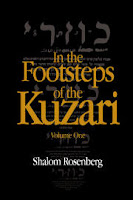
In the Footsteps of the KuzariAn Introduction to Jewish Philosophy
by Shalom Rosenberg
(link to the book's webpage)
In the Footsteps of the Kuzari is an exciting work that guides readers through Judaism’s views on the most pressing philosophical issues of the day. Combining a keen sensitivity to the religious dilemmas of our day with the intellectual rigor of the university, this book serves as an introduction to Jewish philosophy, and unapologetically argues that Judaism presents a coherent and sophisticated religious worldview that is as relevant today as it has been for millennia. Building on the classic work of Jewish thought, The Kuzari, noted Orthodox thinker Prof. Shalom Rosenberg takes readers through the Jewish views that have been voiced throughout the ages and shows how they can be transformed into a compelling worldview in this postmodern age. Intellectually stimulating and philosophically creative, this important work made large waves when published in Hebrew and is now being offered to the English reading public. Take a tour through Jewish philosophy over the ages, from the Talmud to Maimonides to Rav Kook and beyond, and learn where the next stage of Jewish thought will take us.
The book addresses such pressing issues as:
- The sources of the individual’s religious experience,
- Religious truth in the context of changing intellectual trends and fads,
- Jewish uniqueness and the nations of the world,
- The relations between the individual and the collective,
- The challenges of educating toward a rich religious life.
Learn more about the book here: link
Download a chapter from the book here: link (PDF)
Buy the book here: link






